

Product · Automation systems
Industrial Automation Systems Built Around Your Process
An automation system is more than a PLC in a box. It is the control architecture, the I/O, the panel that houses it, the logic that runs it and the screens operators use every shift. Sparsh Automation supplies PLC, HMI and SCADA packages tailored to the way your production process actually runs.
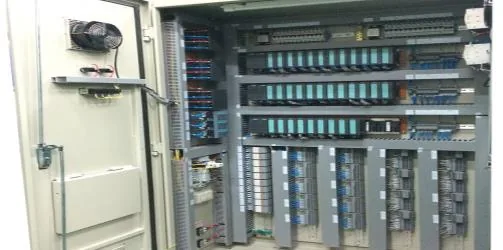
Overview
Because design, programming, panel manufacturing and commissioning sit under one roof, the system you receive is engineered as one piece — not assembled from separate vendors who each own a fragment of the problem.
In our brochure“PLCs, HMIs, and SCADA packages tailored to optimize your production processes.”
Looking only for programming on hardware you already have? Go to PLC programming services
Capabilities
What our solution covers
Control architecture
Selection of PLC platform, I/O count and distribution, communication networks and HMI/SCADA layer to suit the process and your maintenance team's familiarity.
PLC hardware and panels
Controller, I/O, power supplies, protection and field interfaces built into a properly designed control panel.
Application software
PLC logic, HMI screens and SCADA applications developed to your operating philosophy — sequences, interlocks, alarms and recipes.
Drive and motor integration
VFDs and motor starters integrated with the controller over hardwired I/O or industrial networks.
Testing and commissioning
Pre-dispatch checks, on-site installation support, I/O verification and loop testing before handover.
Typical deliverables
- Control system architecture and bill of materials
- Electrical schematics and panel GA drawings
- Manufactured and tested control panel(s)
- PLC program and HMI/SCADA application with documented tags and alarms
- Commissioning support and system handover
Final scope and deliverables are agreed in the quotation for each requirement.
Typical applications
- Process lines with pumps, tanks, valves and dosing
- Machine automation for OEMs and machine builders
- Material handling, conveying and packaging
- Utility systems such as compressors, chillers, boilers and water treatment
- Multi-machine supervision and production monitoring
Technical considerations
General engineering guidance to help you plan and specify.
- Platform choice
- The PLC brand should match your spares strategy and your team's software skills, not just the initial price.
- I/O and expansion
- Leaving spare I/O and panel space keeps future additions cheap. We recommend agreeing an expansion margin at design stage.
- Communication
- Decide early which devices need to talk to each other — drives, meters, remote I/O, SCADA — so the right network and protocol are specified.
- Documentation
- Drawings, tag lists and commented programs are what make a system maintainable years later. They should be part of the scope, not an afterthought.
Process
How the engagement works
- 01
Requirement study
Understand the process, existing equipment, operating philosophy and constraints.
- 02
Design & engineering
Architecture, schematics, panel layout and bill of materials for approval.
- 03
Build & program
Panel manufacturing in parallel with PLC and HMI/SCADA development.
- 04
Test
Panel testing and software checks before dispatch.
- 05
Commission & support
Installation support, site testing, handover and after-sales service.
FAQ
Industrial Automation Systems: common questions
Which PLC brands do you work with?
Our brochure lists Siemens, ABB, Schneider Electric, Rockwell Automation and Mitsubishi Electric among the brands in our ecosystem. Share your preferred platform or existing installed base and we will confirm suitability during the requirement study.
Can you automate a machine that currently runs on relays and timers?
Yes. Converting relay logic to a PLC is a common starting point for automation. We study the existing circuits, document the sequence and propose a PLC-based system with an HMI where useful.
Do you supply only the panel, or the complete system?
Either. We can deliver a complete system — design, panel, programming and commissioning — or only the parts you need. The scope is agreed during the quotation stage.
What information do you need for a quotation?
A short description of the process or machine, approximate I/O or list of motors, valves and sensors, any preferred brands, and whether HMI or SCADA is required. Existing drawings or photos help a lot.
Enquire about Industrial Automation Systems
Tell us about your requirement. Drawings, photos and part numbers can be shared by email after you submit.
Discuss your automation requirement with an engineer
Share your process, drawings or part numbers. We'll review the requirement and get back to you with the next steps and a quotation.